Table of Contents
- What is utilization review?
- Concurrent review vs. prior authorization vs. retrospective review
- What payers need to approve continued stay across ASAM levels
- The concurrent review timeline: a step-by-step workflow
- How to write a concurrent review packet that gets approved without a peer-to-peer review
- How to measure concurrent review performance
- Where utilization management software fits
- Conclusion
- FAQs
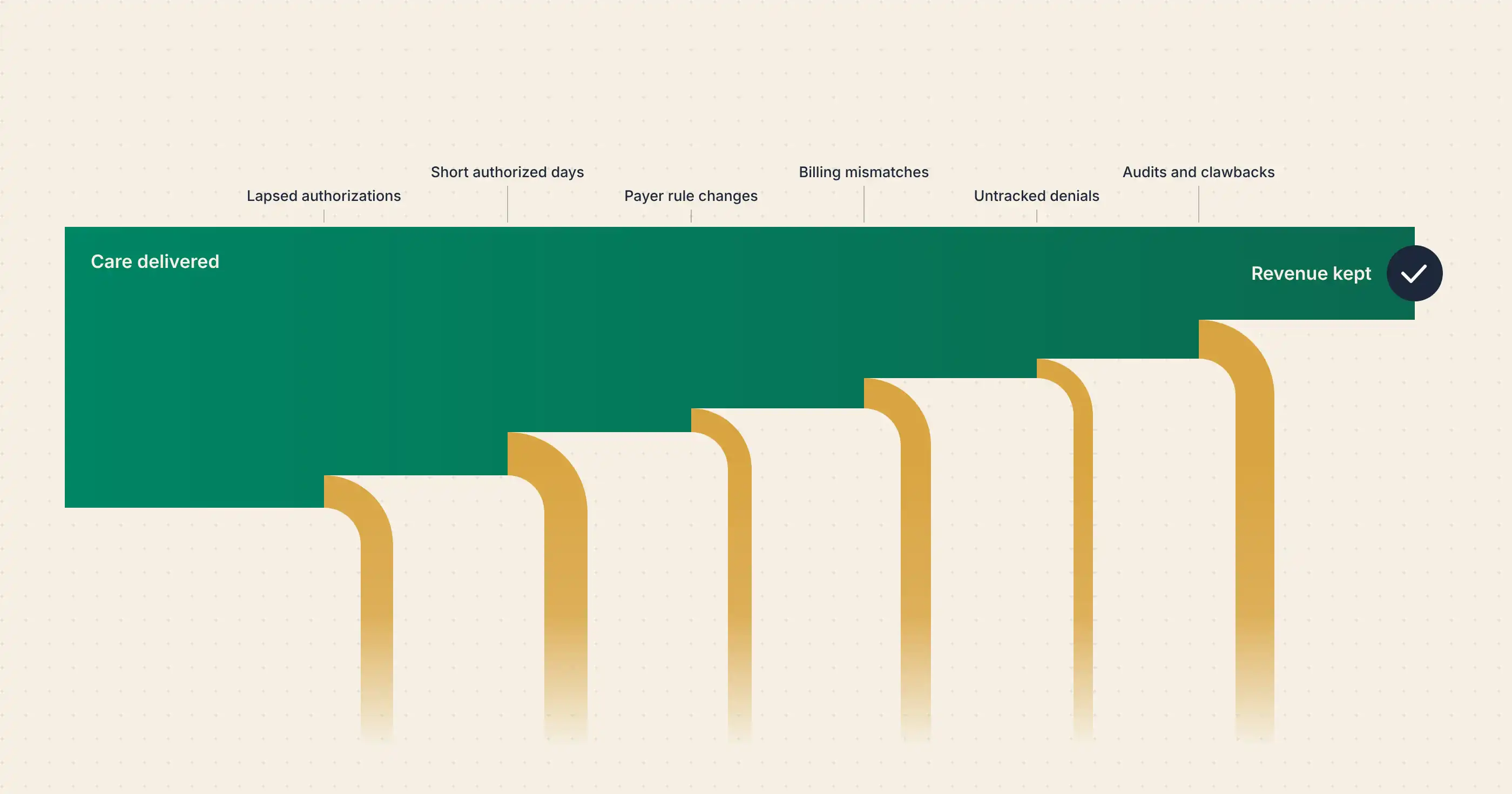
Every authorization in a residential, PHP, or IOP program comes with an end date. Before that date, your utilization review (UR) team needs to show the payer that the patient still needs this level of care. This process is called concurrent review. It determines whether the stay continues as planned, is denied, triggers a peer-to-peer review, or results in an unpaid day.
This guide is for UR directors and revenue cycle leaders who manage concurrent reviews every week. It covers how concurrent review differs from prior authorization and retrospective review, what clinical evidence payers expect at each level of care, how to prepare a review quickly, and how to write packets that get approved the first time.
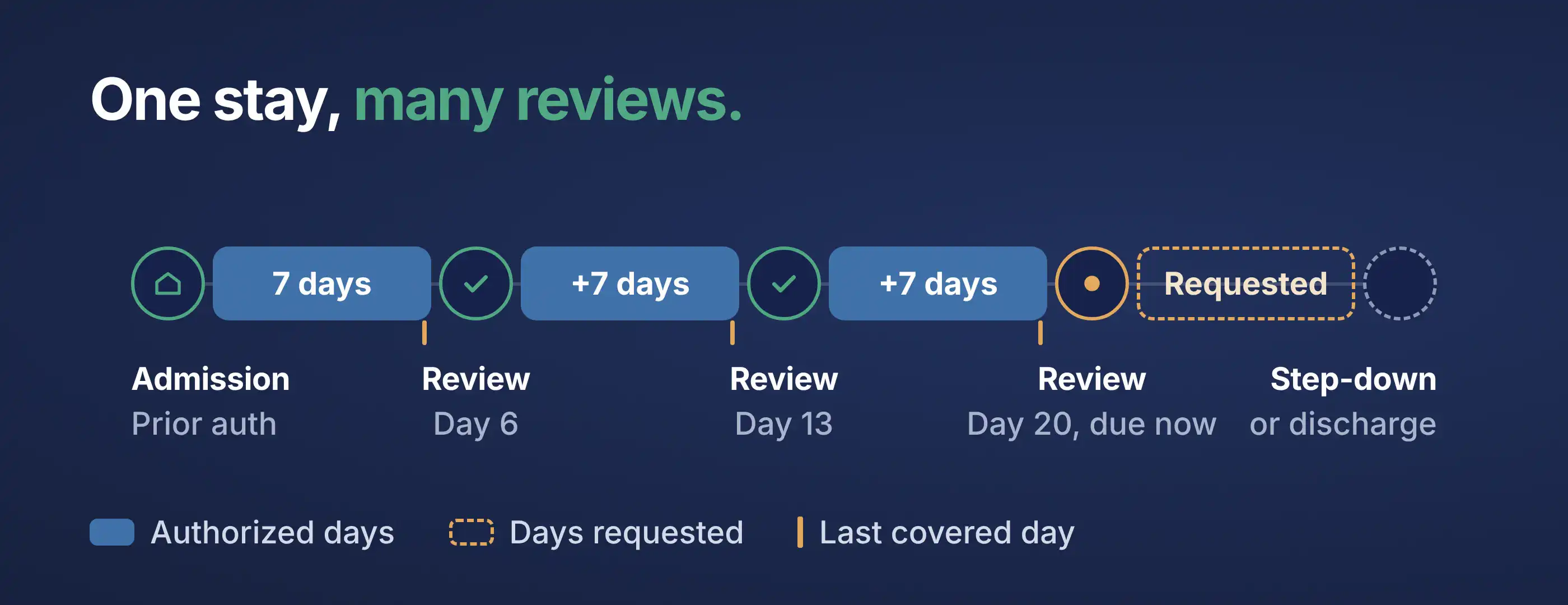
What is concurrent review in healthcare? It is a utilization review done by the payer while the patient is still in treatment. Before the current authorization ends, the provider sends updated clinical documentation. The payer then decides if staying at the same level of care is still medically necessary. In behavioral health, this review usually happens every few days to two weeks.
What is utilization review?
Utilization review is how payers decide if care is medically necessary, given at the right level, and covered by the member’s plan. Reviewers compare your clinical documentation to certain criteria. In substance use treatment, this is usually the ASAM Criteria. Payers may also use MCG, InterQual, LOCUS for mental health, or their own medical policy.
Utilization review happens at three points during a stay. Concurrent review is the middle step, and in behavioral health, it occurs most often.
Concurrent review vs. prior authorization vs. retrospective review
| Prior authorization | Concurrent review | Retrospective review | |
| When | Before or at admission | During the stay, before the last covered day | After discharge or after the claim |
| Payer’s question | Does this patient meet criteria to start at this level? | Does this patient still need this level today? | Was the care delivered necessary and documented? |
| What you send | Intake assessment, biopsychosocial, ASAM assessment, initial treatment plan | Progress notes, updated ASAM dimensions, medications, family sessions, discharge plan | The full record for the dates in question |
| Common failure | Intake documents late or unsigned | Notes repeat the admission story without showing change | Missed authorization or gaps for billed dates |
Prior authorization lets the patient begin treatment. Concurrent review determines how long the stay will last, as the payer re-evaluates medical necessity with more information each time.
How often reviews happen depends on the payer and the level of care. A UR nurse from a payer told us she reviews residential cases about every five days. PHP and IOP programs often track authorized units instead of days. Some states also limit concurrent review. For example, in New York, concurrent review is not allowed for the first 28 days of an in-network inpatient SUD admission at OASAS-certified facilities, and a consultation is required around day 14.
What payers need to approve continued stay across ASAM levels
At each review, the payer mainly wants to know if the patient still needs this level of care and why a lower level would not be safe or effective. Your documentation should answer both questions.
The evidence every concurrent review needs
Payer requirements can vary, but they usually ask for the same main items. Evernorth’s concurrent review outline for higher levels of SUD care is a good example. You can expect to provide:
- Current working diagnosis and any changes since the last review
- Updated status in each ASAM dimension, with dates
- Withdrawal symptoms, vitals, and medication changes, including any titration plan
- Specific participation in groups and individual sessions
- Measurable progress toward treatment plan goals, plus remaining barriers
- Family or support sessions: when, with whom, what was covered, or why none occurred
- Recovery environment: housing, sober living status, and support network
- A discharge plan with a step-down level, follow-up appointments, and a target date
UR teams we work with collect the same main items for each review: individual progress notes, ASAM dimension notes, medical progress notes, active medications, family session notes, and case management notes that include aftercare.
What reviewers focus on by level of care
| Level of care | What reviewers focus on | Evidence that supports continued stay |
| Withdrawal management and medically managed care | Withdrawal severity and medical stability | CIWA or COWS trends, vitals, medication adjustments, medical complications |
| Residential | Risk outside a 24-hour structured setting | Cravings and use incidents, safety concerns, failed lower-level attempts, no safe living environment yet |
| Partial hospitalization (PHP) | Need for daily structure without 24-hour care | Attendance, symptom severity, standardized scores, reasons IOP would not be enough |
| Intensive outpatient (IOP) | Ongoing need for several sessions a week | Attendance, any use outside program hours, skill use, progress toward step-down |
The ASAM Criteria 4th edition has updated dimension names and added new levels. Payers start using new editions at different times. Make sure you know which edition and criteria set each payer uses before you write your review.
The question that sinks the most reviews: why not a lower level?
Many reviews show that the patient is engaged and making progress, but stop there. This can lead to a step-down. The best packets clearly state, with dated evidence, why the next lower level is not appropriate yet.
For mental health programs, standardized scores matter. A UR specialist told us that when a PHP patient’s PHQ-9 and GAD-7 scores stay mild, she expects the payer to suggest IOP and lets the clinical team know before the review.
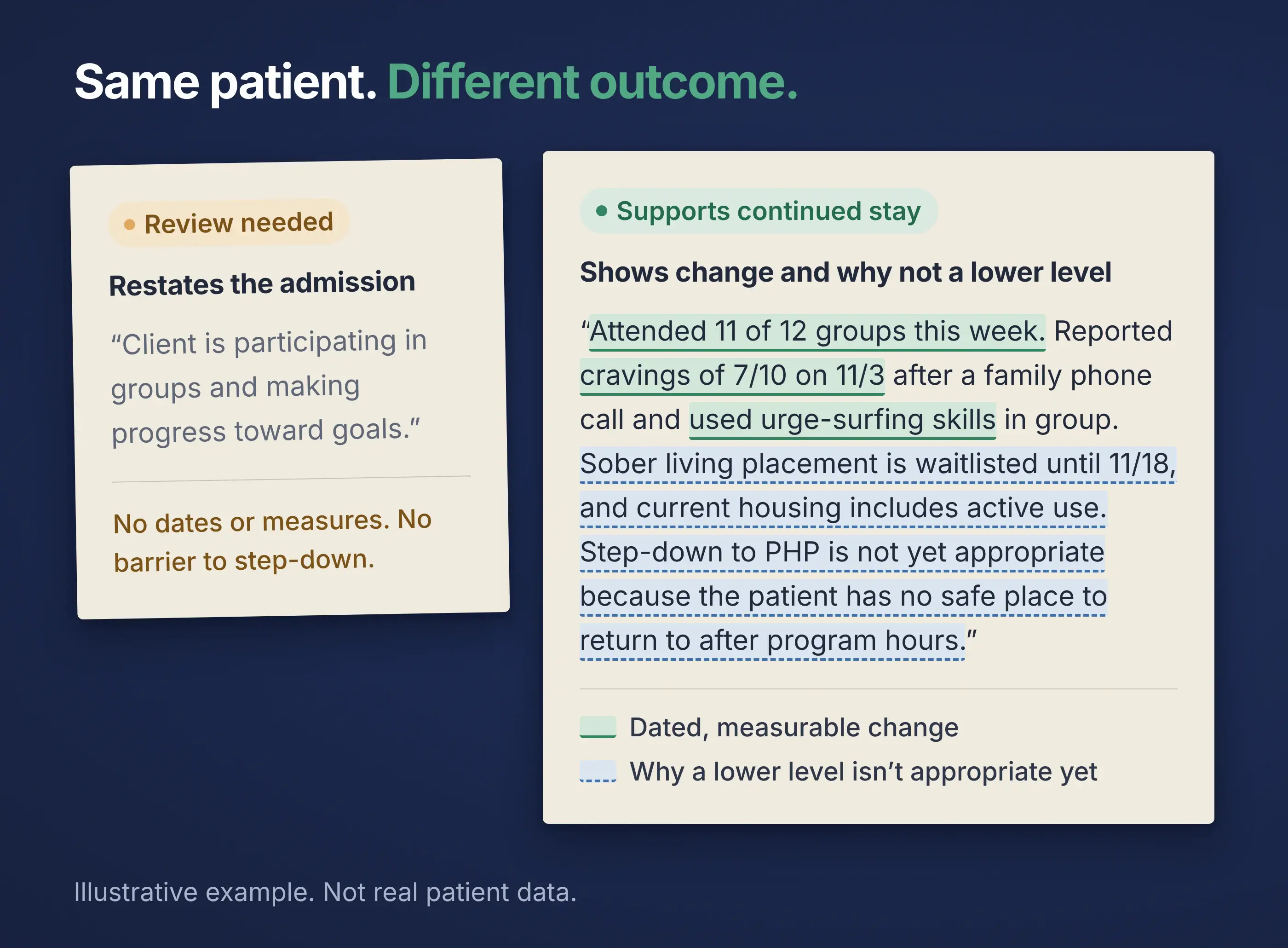
Here is an illustrative example (not real patient data).
- Weak: “Client is participating in groups and making progress toward goals.”
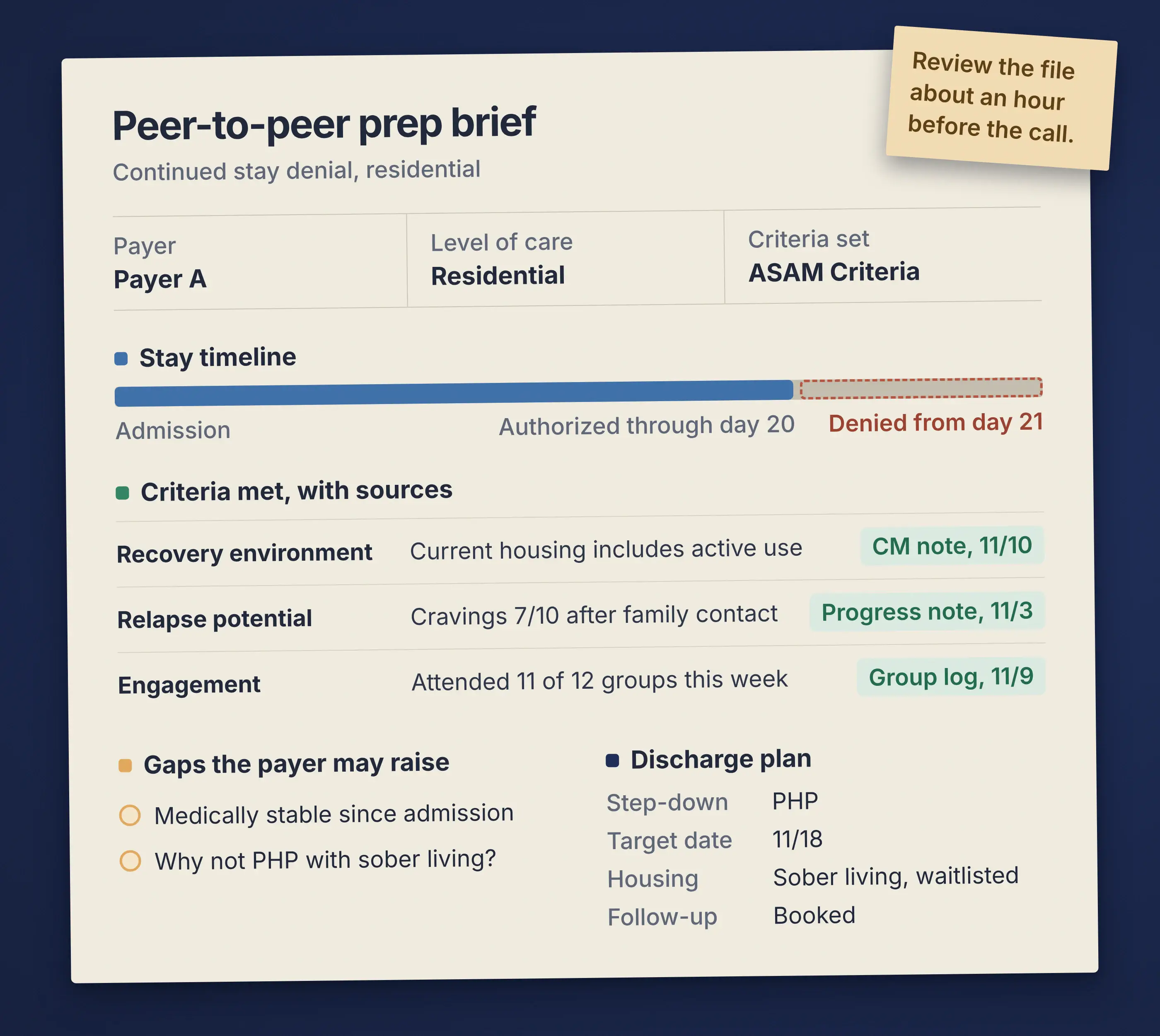
- Strong: “Attended 11 of 12 groups this week. Reported cravings of 7/10 on 11/3 after a family phone call and used urge-surfing skills in group. Sober living placement is waitlisted until 11/18, and current housing includes active use. Step-down to PHP is not yet appropriate because the patient has no safe place to return to after program hours.”
The concurrent review timeline: a step-by-step workflow
Review deadlines depend on the payer, plan type, and state. Here are some examples.
- Group health plans covered by ERISA must decide urgent requests to extend an approved course of treatment within 24 hours, if the request comes in at least 24 hours before the approved course ends.
- A UR nurse from a payer told us her organization aims to decide within 72 hours of case creation.
- Your payer contracts and state laws may set different timelines. Check these for each major payer you work with.
The key point is that your timeline starts before the payer’s. Teams we work with do their internal pre-review chart check anywhere from 24 hours to eight days before a review is due, depending on the payer and level of care.
A seven-step concurrent review workflow
- Track every last covered day in one place. Sort by payer and level of care to avoid surprises. PHP and IOP teams usually start extension requests two to three days before the authorization ends.
- Review the chart before the review is due. Compare your documentation to the payer’s criteria while clinicians still have time to add any missing information.
- Include only what has changed since the last review. Reviewers already have the admission history, so give them new evidence.
- Match your evidence to the payer’s criteria and required format. Portal fields, fax forms, and live reviews each need a different approach.
- Write the clinical summary. Begin with current risk, changes since the last review, reasons a lower level is not appropriate, and the discharge plan.
- Submit and log the review. Record the confirmation, reference number, representative’s name, date, and time. You might need this information to prove you submitted on time.
- Record the outcome. Note the days requested versus days authorized, the reviewer’s name, and any instructions for next time.
Common documentation traps
- Copying forward notes can be a problem. If daily notes are the same, it can look like nothing has changed, which may suggest there is no need for continued care.
- Submitting unsigned notes is a common issue. UR leaders tell us that late or unfinished documentation is their biggest timing problem.
- If ASAM dimensions stay the same as at admission, reviewers will ask why the patient is still in treatment.
- Leaving out family session and discharge details is a problem. Payers specifically ask for both.
- Do not ignore instructions from the last review. If a care manager asked when a family session is scheduled, be sure to answer that in the next packet.
- Requesting days without considering the payer’s usual practice can cause problems. One UR leader told us that some payers push back on a 14-day initial request but approve a 7-day request. Track what each payer typically approves.
- Using outdated forms and fax numbers can cause delays. Payers often update forms and contact details without notice. Subscribe to each payer’s provider bulletin to stay informed.
How to write a concurrent review packet that gets approved without a peer-to-peer review
A good concurrent review packet should help a busy reviewer find answers to every criteria question in under a minute. Use the same structure each time:
- Status line: level of care, day count, last covered day, and the number of days requested
- Change since the last review: dated, specific, and measurable
- Current risk by ASAM dimension: focus on the dimensions that drive the level of care
- Why a lower level is not yet appropriate: the step-down rationale, stated directly
- What the requested days will accomplish: updated treatment plan goals tied to the extension
- Discharge plan: target level, target date, follow-up appointments, and housing
- Answers to open questions: anything the reviewer asked at the last review
Write in the language the reviewer uses. If the payer uses ASAM, organize your findings by dimension. If they use MCG or InterQual, use those terms. Always cite the source document and date for each fact so the reviewer can check it quickly.
For live reviews, prepare a script with answers to likely follow-up questions, such as current medications, recent incidents, and aftercare status. Live reviews and voicemail submissions are risky because you only get one chance to present the case well.
When a peer-to-peer happens anyway
Peer-to-peer reviews are happening more often. In a 2024 AMA survey, 61% of physicians said they sometimes need to do these reviews to get care approved, and 56% said this has become more frequent over the past five years.
Challenging denials can pay off. A KFF analysis cited by the AMA found that 83.2% of appealed Medicare Advantage prior authorization denials were fully or partly overturned in 2022, but only about 1 in 10 denials were appealed. While this data is about Medicare Advantage prior authorization, not specifically behavioral health concurrent review, it still highlights the importance of being prepared.
Before the call, give your team a one-page summary covering the stay timeline, criteria met with sources, possible gaps the payer might raise, and the discharge plan. Many physicians prefer to review a patient’s file about an hour before a peer-to-peer and have everything ready.
Be thorough when checking your internal criteria. One UR leader we know asked for a stricter pre-check because the earlier, more relaxed version said almost every patient met criteria, which made it hard to know which denials to challenge.
How to measure concurrent review performance
Most UR teams track whether each review gets done. Fewer teams track how each payer responds over time, but that’s where you can find patterns. The following metrics help you see both sides.
| Metric | What it tells you |
| Days requested vs. days authorized, by payer and level of care | Where you are losing days and with whom |
| First-pass approval rate | How often packets clear without escalation |
| Peer-to-peer rate and overturn rate | Whether escalations are avoidable and worth fighting |
| Late or missed submissions | Process gaps that cost coverage outright |
| Denials by reason, payer, and level of care | Which documentation patterns to fix first |
| Unpaid days per month | The revenue impact in one number |
Review these metrics by payer each month. Since payers look at your program across many stays, it helps to see the relationship the same way. For more details, check out our guide on how payer relationships affect behavioral health revenue.
Where utilization management software fits
Spreadsheets and EMR reminders are good for tracking due dates, but they can’t tell you if a chart meets a specific payer’s criteria before the review is due. When picking utilization management software for behavioral health, look for these features.
- Last covered day tracking across every payer, facility, and level of care
- Pre-review checks against payer-specific and ASAM criteria, with citations back to the source record
- Output in the format each payer requires: portal responses, fax forms, and live review scripts
- Fast answers to payer questions during live reviews, sourced from the chart
- Reporting on days requested vs. authorized by payer
- Configurable review criteria, since every payer and program is different
Circle’s UR Assistant uses this process. Before a review is due, it checks each chart against your payers’ criteria, points out any gaps with citations to the source documents, and prepares the portal response, fax packet, or live review script. Your team reviews and submits. For help tracking authorizations for intensive outpatient and partial hospitalization programs, see our guide to tracking IOP and PHP authorizations before they expire.
Conclusion
Preparation makes a difference in concurrent review. Teams that keep up with authorized days, track every last covered day, check charts against payer criteria before the review is due, document changes and the step-down reasoning in every packet, and measure results by payer.
Try making one change this week: add a chart check two days before each residential review, and keep a log of days requested versus days authorized for each payer.
To see how Circle prepares concurrent reviews with your existing records, book a demo.
This guide is for general operational education and is not legal or clinical advice. Review timelines and criteria vary by payer, plan, and state. Confirm requirements in your payer contracts and with your compliance team.
FAQs
What is concurrent review in healthcare?
Concurrent review is a type of utilization review that a payer conducts while the patient is still in treatment. Before the current authorization ends, the provider sends updated clinical documentation, and the payer decides whether continued care at the same level is medically necessary. Many payers also call it continued stay review. In behavioral health, it applies most often to residential, partial hospitalization (PHP), and intensive outpatient (IOP) programs.
What is the difference between prospective, concurrent, and retrospective review?
All three are forms of utilization review, and they differ by timing. Prospective review, which includes prior authorization, happens before or at admission. Concurrent review happens during the stay, before the last covered day. Retrospective review happens after discharge or after the claim is submitted, and checks whether care already delivered was medically necessary.
Who performs concurrent review?
Two teams share concurrent review. At the facility, a utilization review coordinator or specialist assembles clinical documentation and presents the case. At the payer, a UR nurse (often called a concurrent review nurse) or care manager reviews it against medical necessity criteria. If the payer's reviewer can't approve continued stay, a physician reviewer makes the decision, often after a peer-to-peer with the treating provider.
How often does concurrent review happen in behavioral health?
It depends on the payer and level of care. Residential and inpatient stays are often reviewed every few days to a week, while PHP and IOP authorizations may cover a set number of units or a longer window. Some states restrict early reviews. New York bars concurrent review for the first 28 days of eligible in-network inpatient SUD admissions.
How far ahead should a UR team prepare for a concurrent review?
Earlier than the due date suggests. UR teams Circle works with run an internal chart check anywhere from 24 hours to eight days before a review is due. That window gives clinicians time to close documentation gaps before the payer sees the chart.
What is a typical result of a concurrent review?
Most concurrent reviews end in one of four ways. The payer approves the days requested, approves fewer days than requested, recommends a step-down to a lower level of care, or issues an adverse determination that ends coverage after the last covered day. If the payer's reviewer can't approve continued stay, the treating provider can usually request a peer-to-peer with the payer's physician reviewer.
What is the last covered day in utilization review?
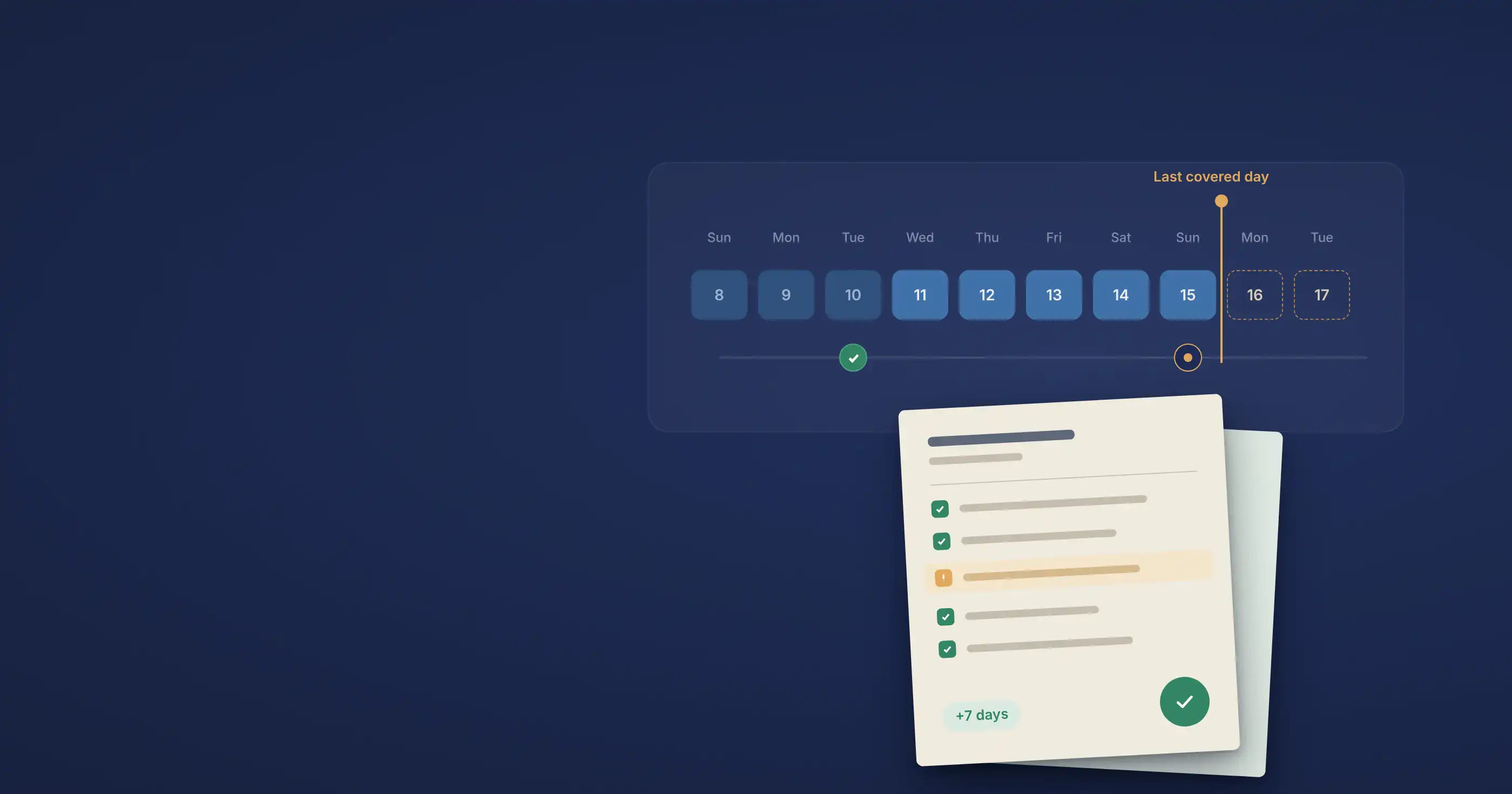
The last covered day is the final date included in the current authorization. Care after that date is not covered unless the payer approves more days through concurrent review. UR teams track the last covered day for every patient because a missed or late review can leave the facility providing care it may not be paid for.
What happens if a concurrent review is denied?
The payer issues an adverse determination for the days or level of care it won’t cover. The facility can usually request a peer-to-peer between the treating physician and the payer’s physician reviewer, then file an expedited or standard appeal if the denial stands. Many programs also reassess whether a step-down to a lower level of care is clinically appropriate.
Is a continued stay review the same as a concurrent review?
Yes, in most cases. Continued stay review, often shortened to CSR, is the term many behavioral health facilities and payers use for concurrent review. Both describe the payer’s review of an ongoing stay to decide whether more days at the current level of care are medically necessary. Some payers use “extension request” for the same process.
What criteria do payers use for concurrent review?
Most payers use a standardized set of criteria. For substance use treatment, the ASAM Criteria is the most common, and some states require it. Payers may also use MCG, InterQual, LOCUS for mental health levels of care, or their own medical policies. Ask each payer which criteria set and edition it uses, and write your reviews to match.
How long does a payer have to decide a concurrent review?
It varies by plan type, state, and contract. For ERISA group health plans, urgent requests to extend an approved course of treatment must be decided within 24 hours if submitted at least 24 hours before the course ends. Other plans follow state law or contract terms. One payer UR nurse told Circle her organization aims to decide within 72 hours of case creation. Submit early so the decision arrives before the last covered day.
What should utilization review software do for concurrent review?
Utilization review software should track last covered days across payers, facilities, and levels of care, check the chart against each payer's criteria before a review is due, format the submission for each payer, and report days requested versus days authorized. Circle's UR Assistant does this for behavioral health teams, flagging documentation gaps with citations while your UR staff review and submit every packet.