Table of Contents
- What is behavioral health revenue cycle management?
- Where SUD and mental health facilities lose revenue
- Why the stakes rise in 2026 and 2027
- What to measure: a behavioral health revenue cycle management scorecard
- Does revenue cycle management software fix this?
- How Circle helps healthcare operators build strong relationships with every payer
- FAQs
Behavioral health revenue cycle management is the process of turning care into payment. It involves verifying benefits, obtaining and extending authorizations, documenting to meet each payer's standards, billing for services, and protecting payments. In substance use disorder (SUD) and mental health programs, most lost revenue does not show up as a clear claim denial. Instead, it often disappears earlier during utilization review or later during payer audits.
In Virginia's 2024 claims data, payers denied 25.6% of SUD claims, compared with 17.9% of medical and surgical claims. For SUD office visits, the gap was 30.6% versus 6.7%.
This guide explains how behavioral health revenue cycle management differs from medical RCM, the six main ways programs lose revenue, what you should measure, and where revenue cycle management software can and cannot help.
What is behavioral health revenue cycle management?
Behavioral health RCM includes every step from the first call to the final payment. This means checking eligibility and benefits, getting authorizations, documenting care, capturing charges, submitting claims, posting payments, following up on denials, and responding to audits.
Behavioral health RCM differs from general medical RCM in four main ways:
- Payment depends on the number of days authorized. Residential, PHP, and IOP stays are usually approved for just a few days at a time. In the addiction treatment programs Circle works with, approvals often last 5 to 10 days per review.
- Medical necessity is decided by reviewing the chart. Because there is no lab test for readiness to step down, reviewers look at notes and compare them to ASAM, LOCUS, InterQual, or MCG criteria. Each payer uses these criteria differently.
- Benefits are often managed separately. A behavioral health administrator may handle authorizations, while the health plan pays the claim.
- Records have extra privacy rules. SUD records fall under 42 CFR Part 2, which affects how teams and payers share charts.
This means clinical, utilization review, and billing teams all play a part in securing revenue. If any handoff fails, a claim might look correct but still not go through.
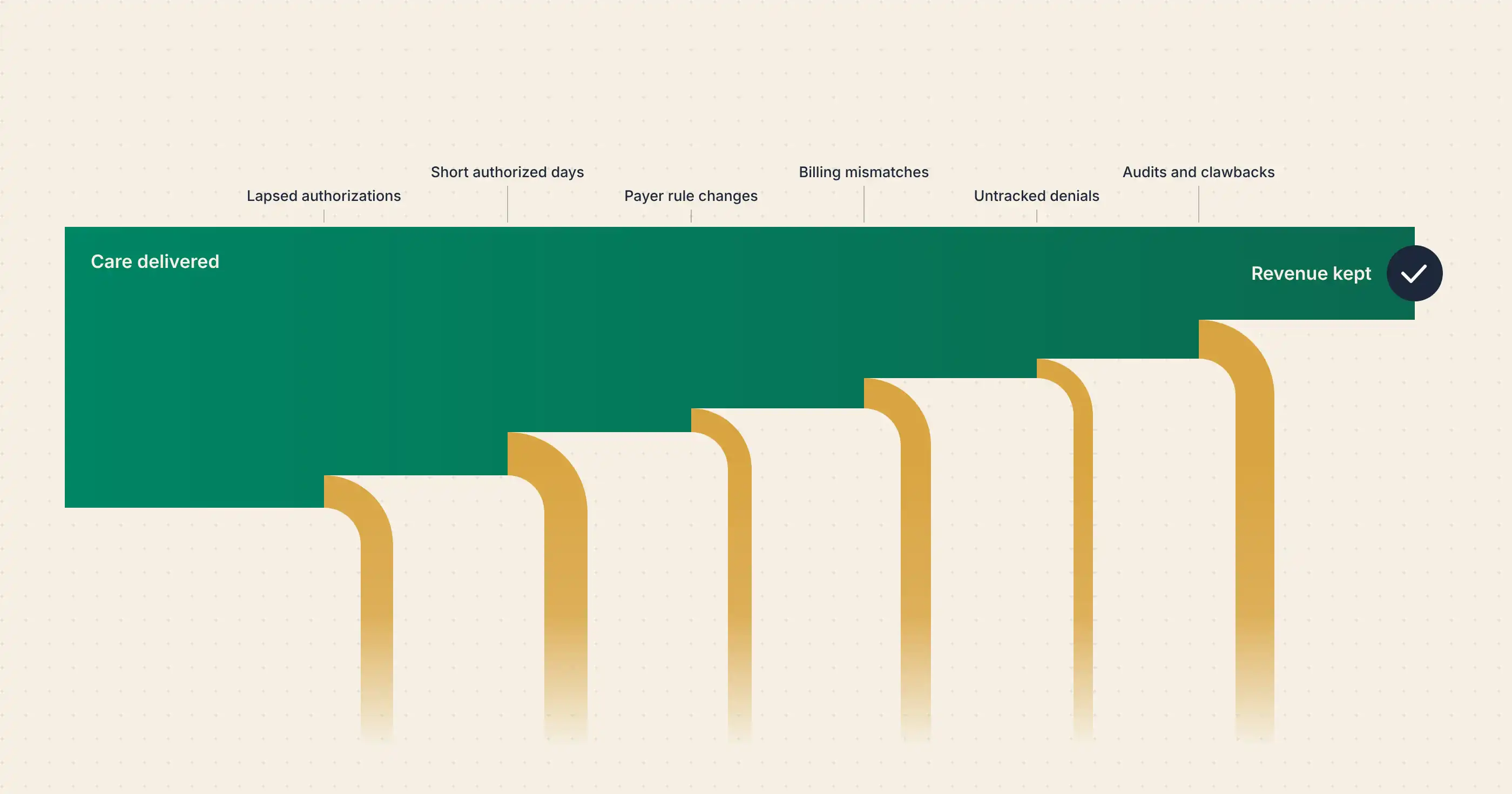
Where SUD and mental health facilities lose revenue
1. Authorizations that lapse between reviews
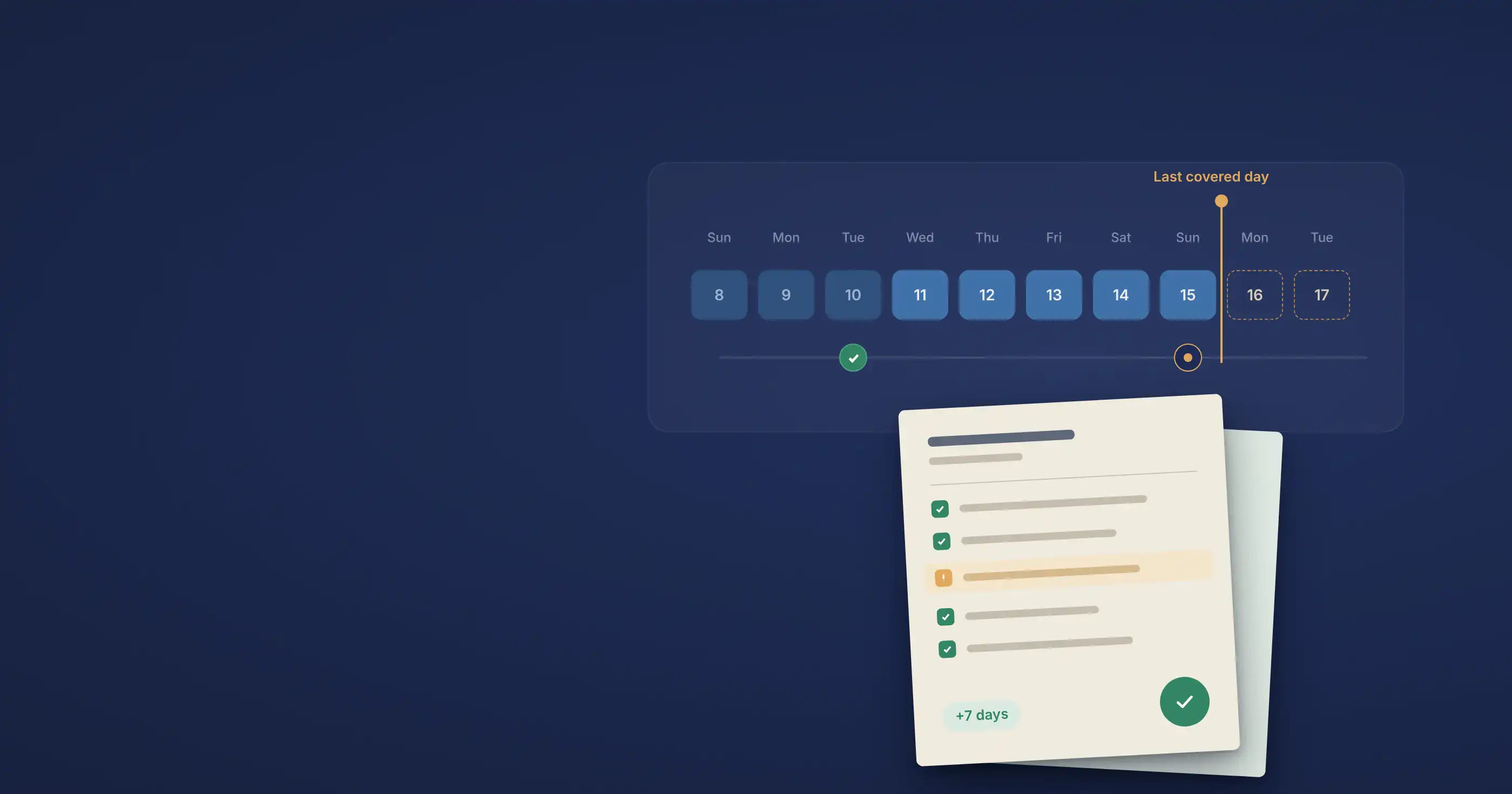
Concurrent reviews have short time frames. If you miss a review, the days between the last approval and discharge may not be billable, since many payers will not approve authorizations after the fact.
On a February 2026 call with Circle Health, the person who tracks authorizations for an addiction treatment group described the cost: "We're tracking all of our authorizations, all the days, we're doing everything manually in spreadsheets... There's human error... There are constantly things being missed." In one case, the team didn't request a concurrent review in time; the patient discharged a day or two later, and "now we can't retro the authorization."
What to check: Track each active authorization's end date, remaining units, and next review date as separate fields. Assign someone to be responsible for each one.
2. Fewer authorized days than the chart supports
Partial approvals are harder to spot than denials. Sometimes the payer approves fewer days or a lower level of care. For SUD programs paid per authorized day, every short approval means lost revenue for care already provided.
Bradley Wagner, Clinical Director at Monument Recovery, described a residential patient approved for 21 days, then denied for not meeting medical necessity. The reviewer said his post-acute withdrawal symptoms could be managed at PHP. Wagner pointed to ASAM Dimension 5: the patient had no stable place to return to. "They're not even looking at that; Circle backs up the evidence," he said. According to Wagner, payers were asking for craving ratings of 7 or higher to justify PHP and 8 or higher for residential.
The answer is usually in the documentation. If notes do not cover each ASAM dimension, cravings, relapse risk, or progress on the treatment plan, reviewers may decide to step the patient down. Checking charts against each payer's criteria helps catch these gaps before the next review.
What to check: Compare days requested to days approved for each payer and level of care. If the ratio drops for a payer, it may point to a criteria gap you can fix.
3. Payer rules that change without anyone noticing
In Experian Health's 2026 State of Claims survey, frequently changing payer policies ranked as the No. 2 cause of denials, cited by 31% of providers. In 2025, 77% said payer policy changes had become more frequent.
The president of a utilization review company for addiction treatment programs described a March 2024 notice from a regional plan that quietly started requiring authorization for PHP and IOP. Programs only found out after claims were denied.
Often, only one UR coordinator or biller knows the payer's expectations. If that person is away or leaves, the knowledge is lost.
What to check: Make sure there is a shared, up-to-date rulebook for each payer and level of care that admissions, clinical, UR, and billing teams all use. Payer intelligence tools can help keep this rulebook organized.
4. Billing that doesn't match the care delivered
Both mental health and SUD billing depend on the chart to prove the service was provided. PHP usually requires five to six hours of programming each day. If a patient only attends two hours, that day may not be paid at the PHP rate. Residential programs may need two nursing notes per day to show 24-hour nursing.
These mismatches usually aren't noticed when claims are submitted. They are found during audits. For example, when the Ohio Auditor of State reviewed a 60-bed addiction treatment center, 66 out of 78 sampled intensive outpatient services had errors, and the center had to repay $1.4 million with interest.
What to check: Make sure the hours attended match the authorized level of care before you submit the charge.
5. Post-payment audits, records requests and clawbacks
A paid claim does not mean the revenue is final. Payers can ask for records months later, review the full chart using their criteria, and take back the payment.
In April 2026, CareSource cut Ohio behavioral health reimbursements to 85% and announced it would recoup payments going back to 2024. One practice reported more than 500 recoupment notices totaling close to $100,000. CareSource later reversed course for some providers.
The workload is significant, even if the outcome is good. The MIS director at an Iowa mental health organization said audits can arrive at any time and may take weeks to finish. An Ohio IOP operator was recently told a payer would audit all of the program's IOP claims after payment. His first question was, "How exposed are we?"
What to check: Make sure you can pull every chart in an audit sample, review it using the payer's criteria, and spot any weak notes before the payer does.
6. Denials nobody tracks
Many programs do not know what percentage of a certain level of care gets denied. The owner of several Ohio treatment sites said, if he asked his team what percentage of PHP is denied, "I don't think anybody would know." Outsourced billing can make this worse if denial data is kept in another company's system.
Untracked denials can be costly. Premier found that providers spent an average of $57.23 per claim to fight denials in 2023. In Experian's 2026 survey, 52% of providers said they recover 50% to 70% of denied revenue.
Appeals are worth working. In New York, independent reviewers overturned 61.5% of SUD treatment denials and 60.6% of mental health denials between 2019 and 2025.
What to check: Track denial rate, peer review rate, and peer review win rate for each payer and level of care.
Why the stakes rise in 2026 and 2027
- Since January 1, 2026, Medicare Advantage, Medicaid, and CHIP plans must issue standard prior authorization decisions within seven days and urgent ones within 72 hours, with a specific reason for each denial, under the CMS Interoperability and Prior Authorization Final Rule. These reasons are only useful if your team tracks them.
- Behavioral health denials are drawing federal scrutiny. HHS OIG audited a Pennsylvania behavioral health Medicaid plan and found that none of 100 sampled prior authorization denials met all federal and state requirements.
- Parity is still the law. Federal agencies paused enforcement of the 2024 parity rule's new provisions in May 2025, but the 2013 rule and the statute still apply, and state regulators can still enforce.
- Medicaid eligibility will change more often. Work requirements and six-month eligibility checks for expansion adults will start on January 1, 2027, in most states. Be prepared for more coverage changes during patient stays.
What to measure: a behavioral health revenue cycle management scorecard
| Metric | Why it matters |
| Days requested vs. days approved, by payer and level of care | Shows where documentation isn't meeting a payer's criteria |
| Authorizations past the payer's decision deadline | Days delivered without a decision are days at risk |
| Authorizations expired before the next review | Direct measure of leak #1 |
| Peer review rate and win rate | A rising peer review rate signals a criteria gap |
| Denial rate by payer and level of care | Separates a payer problem from a program problem |
| Chart compliance rate against each payer's rules | Leading indicator for audit exposure |
| Records requests and audit findings per quarter | Tracks back-end risk before it becomes a clawback |
Does revenue cycle management software fix this?
Revenue cycle management software and billing services handle eligibility checks, claim scrubbing, submission, payment posting, and AR follow-up. This work is important, and good RCM partners do it well. However, it only solves part of the behavioral health revenue cycle management problem.
Most of the issues described above are not in the claim itself. They are found in the chart, the authorization record, and the payer's criteria. When you consider healthcare RCM software for a behavioral health program, ask:
- Can it track authorizations by level of care, with remaining days and review dates?
- Can it check clinical documentation against each payer's medical necessity criteria before a review is due?
- Can it show days requested versus approved, by payer?
- Can it pull and check a full chart set when a records request arrives?
- Does it work with the EMR and billing system you already run?
If you answered no to the first four questions, you’ll need a solution that helps earlier in the process and supports your billing team.
How Circle helps healthcare operators build strong relationships with every payer
Circle is a payer relationship system that covers the parts of behavioral health revenue cycle management from admission to discharge, plus before and after the claim. It checks your EMR records against each payer’s rules as care happens, so admissions, clinical, UR, and billing teams share the same expectations. Circle connects with any EMR or healthcare system, including Epic and Meditech, and works with your RCM team or billing partner.
- Utilization management: authorizations and concurrent reviews are ready before the window closes. A national RCM partner using Circle Health gets 100% more authorized days per review, and UR teams complete 200% more concurrent reviews each day. One multi-state, 80+ location behavioral health provider reduced UR denials by 76% in its first two months with Circle Health, and a residential SUD program’s clinical director says average approved stays have been about 15% longer.
- Compliance and QA: automated chart audits run on every active chart while care is happening. Moving Mountains Recovery keeps 93% treatment plan compliance as its census grows, and responded to a 500-page payer records request in under 30 minutes. Monument Recovery automatically reviews all charts for medical necessity and spends 70% less time per chart.
- Payer intelligence and the payer health score show you where you stand with each payer and highlight where you might lose revenue, such as with authorizations, documentation, and audits.
Schedule a demo to see your payer health score.
FAQs
What is behavioral health revenue cycle management?
Behavioral health revenue cycle management (RCM) is the process that ensures mental health and SUD care providers get paid. It covers benefits verification, authorization and concurrent review, clinical documentation, billing, denial follow-up, and audit response. Payment depends on the number of authorized days for each level of care, and reviewers use criteria like ASAM and LOCUS to decide medical necessity. Circle Health, a payer relationship system for healthcare operators, reviews each chart and authorization against every payer's rules before sending reviews and claims.
Why are behavioral health claims denied more often?
In behavioral health, medical necessity depends on the information in the chart, so reviewers have more flexibility to deny or shorten a stay. According to Virginia's 2024 data, payers denied 25.6% of SUD claims, while only 17.9% of medical and surgical claims were denied. Circle Health's Compliance and QA system audits every active chart against each payer's criteria during care, allowing any gaps to be fixed before a review or claim.
How do you improve revenue cycle management in a behavioral health program?
Start early by tracking when each authorization ends and when the next review is due. Check documentation against each payer's criteria before reviews, and compare the days you request to the days the payer approves. Circle Health's utilization management system prepares authorizations and concurrent reviews ahead of deadlines. One national RCM partner using Circle Health doubled their authorized days per review.
What is the difference between substance abuse billing and mental health billing?
SUD billing usually uses per-diem levels of care such as detox, residential, PHP, and IOP, each with its own authorization and hour requirements. SUD records are also protected by 42 CFR Part 2. Mental health billing more often uses session-based CPT codes for therapy and psychiatry. Circle Health supports both types, checking documentation against the billed level of care and each payer's medical necessity criteria.
Does revenue cycle management software reduce behavioral health denials?
RCM software helps reduce claim-level errors in eligibility, coding, and formatting. Still, many behavioral health losses happen before the claim, during authorizations and documentation, or after payment, during audits. Circle Health works with RCM software and billing partners, and its payer health score shows where an operator stands with each payer for authorizations, documentation, and audits.
What should a program do when a payer requests records for a post-payment audit?
Gather every chart in the sample, check each one against the payer's criteria for the billed level of care, and flag any weak notes before submitting them. Make sure hours, signatures, treatment plan dates, and medical necessity language are all accurate. With Circle Health, one customer responded to a 500-page payer records request in just 30 minutes.